Termite Swarm Emergency in Beloit: Spring Identification & Response Guide
Every spring, Beloit homeowners face a phenomenon that triggers immediate alarm: thousands of winged insects emerging from the soil, foundation walls, or basement floors in coordinated swarms. If you are witnessing a termite swarm inside or around your home, you are looking at evidence of a mature, established colony that has been feeding on structural wood for years. Termite swarms in southern Wisconsin typically occur between late April and early June when soil temperatures along the Rock River corridor reach approximately 70 degrees Fahrenheit and the ground is saturated from spring rainfall. Understanding what you are seeing, how to respond, and what it means for your property is critical for protecting your home from one of the most destructive pests in Rock County.
Subterranean termites cause more structural damage to American homes each year than fires, floods, and tornadoes combined, yet most homeowners carry no insurance coverage for termite damage. In Beloit, where older homes with basement construction, stone foundations, and wood-to-soil contact are common throughout neighborhoods like the East Side, Hackett Street corridor, and areas surrounding Horace White Park, the risk of termite infestation is particularly elevated. A professional termite inspection is the first and most important step when you suspect termite activity in your home.
What Is a Termite Swarm and Why Does It Happen?
A termite swarm is a reproductive event where a mature colony releases hundreds or thousands of winged reproductive termites, called alates or swarmers, to establish new colonies. This event represents the final stage of colony maturation and indicates that the originating colony has reached a population of at least several hundred thousand workers. Swarms do not happen from young or small colonies. By the time you see swarmers, the colony responsible has been active and feeding for a minimum of three to five years.
In Beloit and throughout southern Wisconsin, the Eastern subterranean termite is the primary species responsible for structural damage. These termites live entirely underground or within the wood they consume, making them invisible to homeowners until a swarm occurs or damage is discovered during renovation or inspection. The colony operates in a caste system with workers that forage and feed, soldiers that defend the colony, and reproductives that exist solely to propagate the species.
Swarming is triggered by a combination of environmental factors. When soil temperatures warm sufficiently in spring, typically after several consecutive days above 70 degrees, and the ground is moist from rain, colonies synchronize their release of swarmers. In Beloit, this window usually falls between the last week of April and the third week of May, though unseasonably warm springs can push swarms earlier. The swarmers emerge through mud tubes, cracks in concrete, expansion joints, and around plumbing penetrations in slabs and foundations.
Indoor vs. Outdoor Swarms: What Each Means
The location of a swarm tells you important information about the threat to your home. An outdoor swarm occurring in your yard, garden bed, or near a tree stump indicates that a colony exists on your property but may or may not be actively feeding on your home's structure. These swarms warrant a professional inspection but may not represent an emergency.
An indoor swarm, where winged termites emerge inside your home from basement walls, around window frames, near plumbing fixtures, or from cracks in the foundation floor, is a definitive emergency. Indoor swarms confirm that the colony has direct access to your home's structural components and has been feeding long enough to reach reproductive maturity. Beloit homes with unfinished basements, particularly older properties with limestone or poured concrete foundations, frequently experience indoor swarms where termites exploit cracks and gaps in the foundation to access interior wood framing.
Identifying Termite Swarmers: The Critical Distinction
One of the most common and consequential mistakes homeowners make is confusing termite swarmers with flying ants. Both insects swarm during spring, both are attracted to light, and both shed wings after mating flights. However, the implications of each are vastly different, and misidentification can lead to months or years of unchecked termite damage.
Termite Swarmer Identification
Termite swarmers have a straight, cigar-shaped body with no visible waist constriction between the thorax and abdomen. Their antennae are straight and beaded, resembling a string of tiny pearls. Their four wings are equal in size and nearly twice the body length, extending well beyond the abdomen. The wings are pale and translucent with a fine network of veins. After landing, swarmers quickly shed their wings, and you will often find piles of discarded wings on windowsills, near basement floor drains, or around foundation vents without seeing the termites themselves.
Eastern subterranean termite swarmers found in Beloit are dark brown to black, approximately three-eighths of an inch long including wings. They are weak fliers and tend to cluster around light sources, which is why you frequently find them near basement windows, on windowsills, or collected around light fixtures. Their flight is fluttery and directionless, unlike the purposeful flight of ants.
Flying Ant Identification
Flying ants, particularly carpenter ant swarmers which are also common in Beloit, have a distinctly pinched waist creating a clear three-segment body shape. Their antennae are elbowed, bending at a sharp angle. Their wings are unequal in size, with front wings noticeably larger than hind wings. Carpenter ant swarmers in southern Wisconsin are larger than termite swarmers, typically half an inch or more in length, and have a reddish-brown to black coloration.
While carpenter ants do damage wood, they excavate galleries for nesting rather than consuming the cellulose. Both pests require professional treatment, but the urgency and scope of treatment differ significantly. A confirmed termite swarm demands immediate structural assessment and treatment, while carpenter ant swarms, though concerning, typically represent a less extensive threat to structural integrity.
Collecting Specimens for Identification
If you discover swarming insects in your Beloit home and cannot determine the species with confidence, collect several specimens for professional identification. Place live or dead swarmers in a sealed plastic bag or glass jar. If you only find discarded wings, collect those as well. A pest control professional can identify the species definitively and recommend appropriate treatment. Do not vacuum or sweep up all evidence before the inspection, as the distribution pattern of swarmers and wings helps technicians locate the colony's entry point.
Immediate Response Steps During a Termite Swarm
When you discover a termite swarm in or around your Beloit home, your immediate actions should focus on documentation, containment, and contacting a qualified professional rather than attempting elimination.
Document the Swarm Location and Extent
Photograph or video the swarm location, paying attention to exactly where termites are emerging. Note whether they are coming from a crack in the foundation floor, around a pipe penetration, from a wall void, or from exterior soil. Record the date and time, as this information helps professionals determine the colony's access route and estimate its size. If swarmers are emerging from multiple locations simultaneously, document each point of emergence. Because a swarm signals an established colony nearby, the next step is a thorough termite inspection to locate the nest.
Do Not Spray Insecticides
Resist the urge to spray retail insecticide products on the swarm. Surface sprays kill the visible swarmers but have zero effect on the colony of hundreds of thousands of workers that continues feeding within your home's structure. Worse, spraying can drive the colony deeper into the wood and soil, making professional treatment more difficult and potentially causing the colony to shift its foraging patterns to new areas of your home. The swarmers you see represent less than one percent of the total colony population.
Contain Indoor Swarmers
If swarmers are emerging indoors, you can reduce the nuisance by placing a bowl of soapy water beneath the emergence point. Swarmers attracted to nearby light will fly toward the water surface and drown. This does not affect the colony but prevents swarmers from spreading throughout your living space. You can also vacuum live and dead swarmers with a standard vacuum cleaner for cleanup purposes, but save some specimens in a bag for identification.
Schedule an Emergency Inspection
Contact a licensed pest control company that specializes in termite inspection and treatment immediately. A thorough termite inspection examines the entire structure including basement, crawlspace, foundation walls, sill plates, floor joists, support beams, window frames, door frames, and any area where wood contacts or approaches soil. Inspectors use moisture meters to detect elevated moisture levels that indicate termite activity, and some employ thermal imaging or acoustic detection equipment to identify active galleries within walls without destructive investigation.
Understanding Termite Damage in Beloit Homes
The structural damage that termite colonies cause follows predictable patterns related to building construction methods, soil conditions, and moisture management. Beloit's housing stock presents specific vulnerabilities that homeowners should understand.
Foundation and Sill Plate Damage
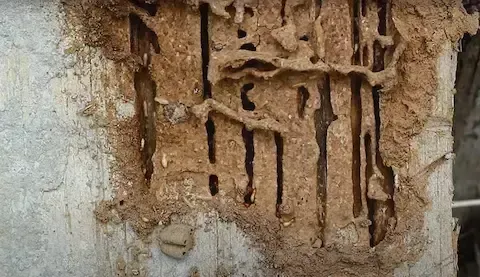
The sill plate, the wood member that sits directly on top of the foundation wall, is typically the first structural component that termites attack. In Beloit's older homes, sill plates were often installed without the pressure-treated lumber or metal termite shields required by modern building codes. Termites build mud tubes up the foundation wall to bridge the gap between soil and wood, then begin consuming the sill plate from the inside out. Damage can progress for years before becoming visible because termites leave a thin outer shell of intact wood while hollowing out the interior.
Homes in Beloit's flood-prone areas near the Rock River and Turtle Creek face compounded risk because periodic flooding saturates foundation soils and can damage waterproofing membranes, creating ideal conditions for termite colony establishment adjacent to foundations. Properties along Riverside Drive, in the Eclipse Center neighborhood, and near Big Hill Park are particularly susceptible to these combined moisture and termite pressures.
Floor Joist and Subfloor Damage
After establishing in the sill plate, termite colonies extend their foraging into floor joists and subflooring. Sagging floors, soft spots when walking, and unexplained squeaking can all indicate termite damage to these structural components. In severe cases, floor joists lose sufficient cross-section that they can no longer safely support loads, creating potential collapse hazards. Homes with unventilated crawlspaces that trap moisture are at highest risk for extensive joist damage.
Wall Framing and Hidden Damage
Termites traveling through wall studs can reach upper floors and even attic framing without ever being visible. Bubbling or peeling paint, hollow-sounding walls when tapped, and hairline cracks in drywall that do not correspond to normal settling can indicate termite damage within wall cavities. In Beloit's balloon-frame homes built before 1940, wall studs extend continuously from foundation to attic, providing an uninterrupted pathway for termites to travel the full height of the structure.
Professional Termite Treatment Options for Beloit Properties
Modern termite treatment has evolved far beyond simply spraying chemicals around a foundation. Licensed professionals employ targeted strategies selected based on the colony's location, the home's construction, and the property's specific conditions.
Liquid Barrier Treatments
Liquid termiticide applications create a continuous chemical barrier in the soil surrounding and beneath a structure's foundation. Modern non-repellent termiticides like fipronil and imidacloprid are undetectable to termites, which means foraging workers pass through the treated zone and carry the active ingredient back to the colony. This transfer effect eliminates the colony over a period of weeks to months rather than simply repelling termites to find alternative entry points.
Application involves trenching along the foundation exterior, drilling through concrete slabs where they abut foundation walls, and treating the soil beneath basement floors through rod injection. In Beloit homes with limestone foundations, treatment requires understanding the porosity and drainage characteristics of the foundation material to ensure proper chemical distribution. A qualified applicator adjusts technique and volume based on soil type, which varies across Beloit from the sandy loam near the Rock River to heavier clay soils in the upland neighborhoods.
Baiting Systems
Termite baiting systems use in-ground stations positioned around the structure's perimeter that contain wood monitoring devices or bait matrix. When termites discover and begin feeding on a station, the monitoring device is replaced with a bait containing a slow-acting insect growth regulator or metabolic inhibitor. Foraging workers consume the bait and share it with nestmates through their social feeding behavior, eventually eliminating the entire colony.
Baiting systems offer advantages for properties where liquid treatment is complicated by wells, bodies of water, extensive landscaping, or foundation conditions that make trenching difficult. Several Beloit neighborhoods near Turtle Creek and properties with private wells benefit from the reduced chemical application that baiting systems provide. The drawback is a longer timeline to colony elimination, typically three to six months compared to weeks for liquid treatments.
Wood Treatment and Structural Repair
In areas where termite damage is discovered during treatment, direct wood treatment with borate-based products protects remaining structural lumber from future attack. Borates penetrate wood fibers and remain effective indefinitely as long as the wood stays dry. For Beloit's historic homes where preserving original structural elements is important, borate treatment provides long-term protection without requiring replacement of sound but vulnerable timbers.
Where structural damage has compromised load-bearing capacity, repair or reinforcement is necessary beyond pest control treatment. This typically involves sistering new lumber alongside damaged joists, replacing severely compromised sill plates, or installing supplemental support posts and beams. A qualified contractor working in coordination with the pest control company ensures that repairs address both the structural deficiency and the conditions that allowed termite access.
Long-Term Termite Prevention for Beloit Homeowners
Preventing future termite infestations requires managing the conditions that attract and sustain colonies near your home. Beloit's climate and soil conditions mean that termite pressure is constant, and prevention must be ongoing.
Moisture Management
Subterranean termites require moisture for survival and are attracted to areas with elevated soil moisture. Ensure gutters and downspouts direct water at least four feet away from the foundation. Grade soil so that it slopes away from the home at a minimum of six inches over the first ten feet. Repair leaking hose bibs, air conditioning condensate lines, and basement seepage promptly. In crawlspaces, install a vapor barrier over exposed soil and ensure adequate ventilation. Beloit properties with sump pump systems should verify that discharge points are far enough from the foundation to prevent reintroduction of water near the structure.
Wood-to-Soil Contact Elimination
Any wood that contacts soil provides direct termite access without the need for visible mud tubes. Common violations in Beloit homes include fence posts, deck posts, porch supports, and landscape timbers that contact the ground adjacent to the structure. Firewood stacked against the foundation is a frequent contributor to termite problems. Maintain a minimum of six inches of clearance between soil grade and any wood structural element, and use pressure-treated or non-wood materials for any element that must contact the ground.
Regular Professional Inspections
Annual termite inspections by a licensed professional provide the earliest possible detection of new activity. Inspectors identify changes in moisture conditions, new mud tube construction, and fresh damage that homeowners typically miss during casual observation. For Beloit homes that have received previous termite treatment, annual inspections verify that the treatment remains effective and that new conditions have not created vulnerabilities.
If you have witnessed a termite swarm in or around your Beloit home, do not delay professional assessment. The colony that produced those swarmers has been established for years and is actively damaging your home's structure. Early detection and treatment limits damage and reduces repair costs significantly.
