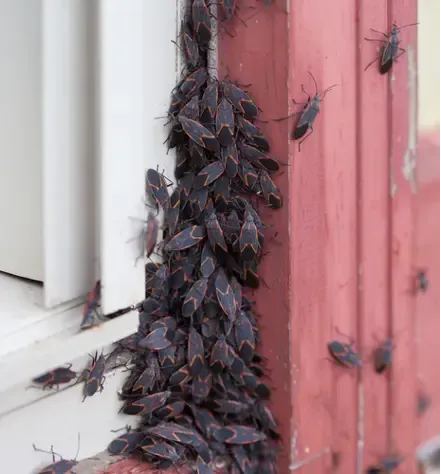
Asian Lady Beetles Inside Beloit WI Homes Each Fall
Every October, homeowners across Beloit start noticing something unusual — small orange-and-black beetles gathering on south-facing walls, clustering around window frames, and eventually squeezing through gaps into living spaces. These are Asian lady beetles, and while they look harmless enough, a large indoor cluster creates real problems. They release a foul-smelling yellowish fluid when disturbed, they stain light-colored surfaces, and once they find a warm wall cavity or attic space, they settle in for the winter whether you want them to or not.
What Makes Asian Lady Beetles Different From Native Ladybugs
Most people grew up thinking ladybugs were garden helpers — and they are. But the Asian lady beetle (Harmonia axyridis) introduced by the USDA in the 1980s to control agricultural aphids is a different story when fall arrives. Native ladybugs overwinter outdoors under leaf litter and bark. Asian lady beetles evolved to find structures, drawn specifically to light-colored buildings and reflected sunlight on warm exterior walls. That's why homes along the Rock River corridor and older neighborhoods near Beloit's downtown core see heavy congregations on sunny fall afternoons.
Identification matters here. Asian lady beetles are slightly larger than native species, ranging from tan to orange-red with variable black spotting. The clearest marker is an M-shaped black marking just behind the head on the white pronotum. If you're seeing dozens of beetles piling up on your window sills or in ceiling corners, you're almost certainly dealing with this species, not a native ladybug.
Why Beloit Homes Are Particularly Vulnerable Each Fall
Rock County's geography plays a direct role in when and how badly beetle pressure hits. Beloit sits at a latitude where the seasonal temperature swing is sharp. Asian lady beetles are triggered by dropping temperatures and shorter daylight hours, and in this region that transition typically happens fast — often in a two-to-three week window in late September and October. When temperatures dip into the low 50s and the sun angle drops, beetles that have been feeding all summer on aphids in soybean and corn fields surrounding Beloit begin migrating toward structural heat sources.
Homes on the south and west sides of neighborhoods, buildings with older wood trim, gaps around utility penetrations, and homes with shake siding or cedar accents tend to draw the heaviest beetle loads. The beetles follow pheromone trails, which means once a structure has been used as a winter harborage, it will continue to attract beetles year after year unless the treatment and exclusion cycle is broken. That recurring draw is one reason Rock County homeowners often report the problem getting worse each season rather than better.
What Actually Works to Stop Them
There are two components that matter: exterior perimeter treatment timed to beetle migration, and physical exclusion of entry points. Both need to happen before beetles begin entering the structure in large numbers — typically before mid-October in the Beloit area.
Exterior residual insecticide applications targeting the south and west walls, roofline, window and door frames, and soffit areas create a treated zone that stops beetles before they find entry points. The timing window is specific. Applications need to be in place when daytime temperatures are still warm enough that beetles are active on exterior surfaces. Once beetles have moved inside wall voids or attic spaces, surface treatments are no longer effective and physical removal becomes your only real option.
Physical exclusion — sealing gaps around utility lines, vents, windows, and soffits — reduces entry even when chemical treatment is applied. This is worth doing regardless of beetle pressure because the same gaps that let beetles in also allow heat to escape and moisture to enter. Foam backer rod and exterior-grade caulk handle most small gaps. Larger openings around soffit vents should be covered with fine mesh.
For ongoing seasonal protection across Rock County properties, Box Elder control programs address the full cluster of fall-invading insects — including Asian lady beetles, boxelder bugs, and western conifer seed bugs — with coordinated exterior treatment before the migration window closes.
What Not to Do When Beetles Are Already Inside
Once beetles are in the living space, there's a right and a wrong approach. The single biggest mistake homeowners make is reaching for a can of spray insecticide inside the home. Killing beetles inside does nothing to stop the ones outside, and it leaves dead insect material in wall voids that can attract secondary pests like carpet beetles and dermestid beetles. Residual sprays applied to indoor surfaces also don't prevent new beetles from entering.
The practical indoor method is vacuuming. Use a vacuum cleaner — ideally with a bag or a mesh filter bag placed inside the hose — to collect beetles without crushing them. Crushing releases that foul defensive fluid and can leave yellowish staining on walls, carpet, and fabric. Empty the vacuum bag outside immediately. This approach won't solve the root problem but it manages the indoor population without making things worse.
Sticky traps placed near south-facing windows can capture beetles that cluster at light sources but won't reduce overall pressure. Light traps marketed for indoor beetle control have very limited effectiveness for this species and aren't worth the investment as a primary control tool.
The Pheromone Trail Problem and Why It Gets Worse Each Year
One aspect of Asian lady beetle biology that catches Beloit homeowners off guard is the aggregation pheromone these insects leave behind. When beetles successfully overwinter in a location, they leave chemical traces on the exterior that attract new populations the following fall. If you had a bad beetle year in your home last October, your exterior is already marked. Without treatment to disrupt that cycle, pressure increases year over year rather than stabilizing.
This is why a single season of effective exterior treatment followed by targeted exclusion work tends to produce noticeable results the following year. You're not just stopping this fall's beetles — you're reducing the pheromone signal that would otherwise draw next fall's population to the same spots.
For background on the related cluster of fall invaders that includes both boxelder bugs and Asian lady beetles, the box elder bug guide covers identification and seasonal timing for the full group of insects that share the same fall invasion pattern across southern Wisconsin.
Getting the Timing Right in Rock County
The treatment window for Asian lady beetles in Beloit is narrow. You're working with a roughly three-to-four week period in early-to-mid fall when temperatures are dropping but beetles are still active on exterior surfaces. Once overnight temperatures consistently fall below 40 degrees Fahrenheit, beetles that haven't entered structures have largely moved into their harborage sites and the exterior treatment window has closed.
In practice, this means the time to act is late September through early October in most years. Scheduling exterior treatment early in that window gives the residual application maximum effectiveness and ensures coverage is in place before the peak migration event. Waiting until you see beetles inside means the outdoor population has already found its way through your building envelope, and control at that point shifts from prevention to damage management.
Beloit's fall pest season is predictable enough that scheduling treatment in advance — before the first visible beetle activity on exterior walls — gives you the best outcome with the least disruption to the interior of your home.
