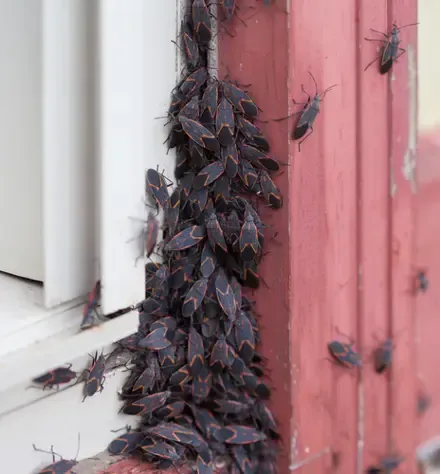
Stink Bugs on Beloit WI Siding Through Late Fall Days
By mid-September, south-facing walls in Beloit start attracting an unwelcome crowd. Brown marmorated stink bugs congregate on siding, brick faces, and window trim as temperatures swing between warm afternoons and cold nights. They are not damaging the structure or reproducing on your exterior — they are using the thermal mass of the building to regulate body temperature before pushing inside for winter. That behavioral pattern is what makes timing so important. Once they move through gaps and into wall voids or attic spaces, control becomes considerably harder.
Why Beloit Siding Becomes a Target Each Fall
Rock County sits in a climate band where autumn temperature swings are pronounced. A wall that absorbs afternoon sun in October can be ten to fifteen degrees warmer than the ambient air by mid-afternoon. For a cold-blooded insect trying to stay active as long as possible before diapause, that warmth is exactly what it is looking for. Stink bugs — formally the brown marmorated stink bug, Halyomorpha halys — are a relatively recent arrival to Wisconsin, but populations in the Beloit area have established firmly over the past decade as they expanded from initial Midwest entry points.
South and west-facing walls see the heaviest aggregations because they collect the most direct light in the afternoon hours. If your home has tan, brown, or gray siding, the heat absorption is even greater, and the bug load can be noticeably higher than on lighter surfaces. Neighbors with similar homes may compare notes and find the pattern holds consistently across the neighborhood.
The Window and Entry Point Problem
The exterior congregation phase is the visible part. What matters structurally is where those bugs go next. Stink bugs are surprisingly capable at finding entry points. They exploit gaps around window frames, deteriorating caulk lines, openings around utility penetrations, soffit vents with damaged screening, and gaps where siding panels meet trim boards. Older homes along the west side of Beloit, particularly those with original wood trim and single-pane windows, tend to have more entry pathways than newer construction.
Once inside a wall void or attic, stink bugs enter a semi-dormant state and cluster in large numbers. They do not breed indoors, and they do not feed on structure or stored goods. The problem is that any warm spell — including the heat from your forced-air system — can cause them to become active mid-winter and find their way into living spaces. When disturbed or crushed, they release a distinctive odor that gives them their name. A vacuum with a bag is the standard removal method for interior individuals, but that does nothing about the hundreds still sheltering in wall voids.
How Treatment Timing Affects Results in Rock County
The window for effective exterior perimeter treatment is specific. Applications made too early, before stink bugs have begun their aggregation movement, miss the population entirely. Applications made too late, after the bulk of bugs have already moved inside, treat insects that are no longer exposed to the product on the exterior surface. The target window in the Beloit area typically runs from early September through mid-October, depending on the year's specific temperature pattern.
Treatment focuses on the exterior surfaces where bugs congregate and the specific entry points they exploit. Perimeter treatment at the foundation, window frames, door frames, soffit lines, and any visible penetration points addresses the transition zone between outside and inside. The goal is not to eliminate every stink bug in the yard — that is not achievable — but to interrupt the movement of aggregating bugs before they find their way into the structure.
For Box Elder control, which often runs parallel to stink bug treatment in the same seasonal window, the timing logic is similar. Both species use exterior sun-warming behavior before attempting to overwinter inside structures, and a single treatment visit can address both pest pressures simultaneously if scheduled at the right point in fall.
What You Can Do Before the Crew Arrives
There are practical preparation steps that improve treatment outcomes. Walk the perimeter of your home and note any gaps where siding meets trim, any caulk lines that have cracked or separated, and any vent or utility openings that lack intact screening. Photograph what you find so you can communicate it clearly. If you have window air conditioning units that are still in place in September, remove them — that gap is one of the most common entry points stink bugs use.
Do not seal openings yourself with expanding foam before treatment. Foam applied over an existing entry point before insects are treated can trap bugs inside and push them toward interior living spaces. The sequence matters: treatment first, then sealing after the product has had time to work.
Inside the home, make sure attic access points are identified. If your attic has a pull-down stair or a hatch, check whether there is a gap around the frame. Attic spaces in Beloit-area homes are frequently where stink bugs overwinter in the largest numbers, and a poorly sealed attic access allows movement downward into the home throughout the winter.
Recognizing the Difference From Similar Pests
Stink bugs are sometimes confused with other fall-aggregating insects common to Rock County. Boxelder bugs are flat and black with red markings and appear on the same south-facing surfaces at similar times. Multicolored Asian lady beetles also aggregate on exterior walls in fall and can enter structures in large numbers. Each pest has distinct behavior and responds to somewhat different treatment strategies, though there is overlap in timing and entry point treatment.
Understanding how seasonal beetle work runs gives useful context for why fall pest control in the Beloit area involves coordinating treatment for multiple species within a short window rather than addressing each separately at different times.
When to Call Rather Than Wait
If you are finding individual stink bugs indoors in October, it is not yet a crisis — a few individuals find their way in through gaps that exist in nearly every home. If you are finding them regularly throughout a room, particularly near windows or along ceiling lines, that suggests a larger population is already sheltered in the wall voids or attic above. That level of interior activity warrants a professional assessment rather than continued vacuuming of individuals. A crew familiar with Beloit-area construction styles and the specific fall pest patterns in Rock County can evaluate the likely entry routes and recommend a treatment and exclusion plan appropriate to the structure.
