Box Elder Bug Control in Beloit WI South Facing Homes
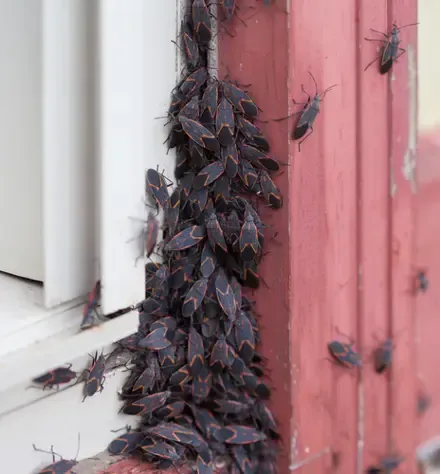
If you live in Beloit, WI and your south-facing siding turns red and black every October, you already know what box elder bugs are. What you may not know is why your house is such a reliable target year after year, and what steps actually reduce that aggregation rather than just temporarily scatter it. Understanding the full seasonal cycle of box elder bugs in Rock County gives you a real advantage when it comes to protecting your home before the overwintering rush begins.
Why South-Facing Walls Attract Box Elder Bugs in Beloit
Box elder bugs are thermophilic insects, meaning they are strongly drawn to heat. As Wisconsin temperatures begin to drop in late summer and early fall, these bugs search for warm surfaces to congregate on before pushing into wall voids and attic spaces to overwinter. South-facing and west-facing walls absorb the most solar radiation during the day, which makes them the primary aggregation points in Beloit neighborhoods from late August through October.
Homes along the Rock River corridor and on the eastern and southern edges of Beloit often experience heavier pressure because mature box elder trees, their primary host, are abundant along those natural waterways and tree lines. Female box elder trees produce the seed pods that sustain large bug populations through summer. If your yard or a neighbor's yard contains a mature female box elder within a few hundred feet, your south-facing siding is almost certainly on the insects' radar by the time September arrives.
The orientation of your home is not something you can change, but knowing it is a contributing factor helps you understand why certain Beloit properties see far greater activity than others in the same neighborhood. A home with a long south-facing brick or vinyl siding wall and a box elder tree on the property can host thousands of insects within days of the first cool weather pattern moving through Rock County.
The Seasonal Behavior Cycle You Need to Understand
Box elder bugs spend the winter hiding inside wall cavities, behind siding, in attic spaces, and in any structural gap they can find. They enter a state of reduced activity and survive on fat reserves. In spring, typically from mid-April through May in Beloit, they emerge from those overwintering sites and move back outdoors to feed on box elder, maple, and ash trees. Egg-laying begins on host trees in early summer, and a second generation of nymphs develops through July and August.
By late summer, the population is at its annual peak. Adult bugs from both the overwintered generation and the new summer generation are active and feeding heavily on seed pods. As nights cool in September and October, the instinct to seek warm surfaces and sheltered spaces intensifies. This is when Beloit homeowners start seeing large clusters on siding, window frames, door frames, and fascia boards.
The fall aggregation is not just an annoyance. It is a sign that bugs are actively probing your home for entry points. Gaps around utility penetrations, weep holes in brick veneer, cracks in foundation sealant, and spaces under siding overlap are all common entry routes. Once they are inside the wall cavity, they are much harder to address and often reappear in winter when they mistakenly emerge into living spaces on warm days, or again in spring as they try to exit.
Summer Treatment Is the Strategy That Changes the Outcome
Most homeowners call for pest control when they see the aggregation on their walls in October. At that point, treatment still has value, but the window for the most impactful intervention has already partially closed. The more effective strategy involves treating host trees and the surrounding ground areas during summer, targeting the nymph population before it reaches adulthood and before the overwintering instinct takes over.
Perimeter treatments applied to foundation zones and lower siding in late July through September create a barrier that reduces the number of insects reaching your walls. When combined with a direct treatment of actively aggregating bugs on siding in early fall, you are working with the biology of the pest rather than reacting to the visible result of a problem that built up over months. This two-phase approach consistently produces better outcomes than a single fall application alone.
For Beloit properties with mature box elder trees on site, tree-based treatment may also be a recommended component. This requires timing and the right products, which is why working with a professional who understands the local Rock County population cycles matters. If you want to take the right steps before the fall rush, Box Elder control services are available to assess your specific property and design a treatment plan that addresses both the source population and the structural entry risk.
What Does Not Work and Why Homeowners Repeat the Mistake
There are a few approaches that see heavy use in Beloit but deliver limited results when used alone. Vacuuming bugs off the siding gives immediate visual relief but does nothing to reduce the population returning from nearby trees. Spraying consumer insecticide on the wall surface can kill contact insects but provides little residual protection and does not address the insects that are already inside the wall cavity.
Cutting down a box elder tree on your property is sometimes recommended, but the impact is often overstated. If neighboring properties, park land along Rock River, or the tree lines east of Beloit toward the county line still have female box elder trees, your population pressure will remain significant. Removal of your own tree may reduce breeding habitat somewhat, but it rarely eliminates the problem entirely.
Caulking and sealing entry points is an important part of long-term management, but it is most effective when done as a preventive measure before the fall aggregation begins. Sealing entry points after bugs have already entered the wall void traps them inside, leading to emergence problems later in the season or during winter warm spells.
Rock County Tree Lines and Regional Pressure
Beloit sits in a part of Rock County where natural and ornamental plantings mix heavily with residential development. The areas around Riverside Park, Special People Park, and the neighborhoods south of the Rock River have significant tree canopy that includes species attractive to box elder bugs. The flat terrain and prevailing wind patterns in southern Wisconsin also mean that box elder bugs can travel substantial distances from host trees before settling on a structure.
This regional context matters when you are trying to understand why treatment pressure is different in Beloit compared to other Wisconsin cities. You are not just managing the bugs originating on your own lot. You are managing your home as one node in a broader landscape where box elder trees are abundant and insect populations rebuild reliably every summer. Understanding that dynamic is part of what separates an effective control strategy from one that addresses only the visible problem on your wall.
Homeowners in newer subdivisions on the south and west sides of Beloit sometimes assume they are less exposed because the landscaping is younger. However, box elder trees grow quickly and become productive seed-pod producers within a few years. Properties that had no box elder bug pressure five years ago can develop significant activity as nearby plantings mature, which is a trend being observed in several developing areas of Rock County.
Structural Exclusion as a Long-Term Component
Pesticide treatment addresses the active population but does not permanently close the structural gaps that allow bugs to enter. For lasting results, exclusion work should follow or accompany treatment. This includes inspecting and sealing gaps around pipes, conduit, and wire penetrations through the foundation or siding, replacing or repairing damaged weep hole covers on brick veneer homes, ensuring window and door frames are properly caulked, and checking soffit and fascia joints for gaps that open up over time.
This kind of work is especially relevant in Beloit's older housing stock, where homes built in the mid-twentieth century may have settled, shifting and creating small gaps that were not present originally. A professional inspection can identify the specific vulnerabilities on your home rather than relying on a generic checklist.
Asian Lady Beetles and the Overlap in Fall Aggregation
Box elder bugs rarely arrive alone. Asian lady beetles, sometimes called Asian beetles or multicolored Asian lady beetles, follow a nearly identical overwintering pattern and are attracted to the same south-facing warm surfaces. In Beloit, it is common to see both species aggregating on the same wall at the same time in September and October. This overlap often leads to confusion about which pest is which and whether a single treatment approach covers both.
The good news is that many of the same perimeter and surface treatments effective against box elder bugs also target Asian lady beetles. A unified treatment strategy for both pests is more efficient than treating them as separate problems. If you want to understand how these treatments are approached for ladybug-style pests alongside box elder bugs, reviewing our honey bee walkthrough offers a useful perspective on how different insect behaviors shape the treatment decisions we make in the field.
Timing Your Response to the Beloit Season
The ideal response calendar for Beloit homeowners looks something like this. In late June and early July, assess your property for host trees and begin monitoring for early nymph activity. In August, consider a preventive perimeter application if your home has a history of heavy fall aggregation. In September, focus on any visible aggregation on siding and ensure your exclusion caulking is intact before insects begin probing entry points. In October, address any remaining aggregation and make note of where bugs are concentrating for targeted work the following spring.
This kind of proactive approach does not eliminate box elder bugs, but it consistently reduces the scale of the fall aggregation and the number of bugs that successfully overwinter inside your home. For Beloit properties that have dealt with this problem for years and feel like nothing is working, the difference is usually timing and the combination of methods rather than any single treatment on its own.
