Rock River Mosquitoes in Beloit Riverside Neighborhoods
If you live within a few blocks of the Rock River in Beloit, you already know the difference. Summer evenings that inland neighbors spend on the porch become something you endure rather than enjoy. The mosquito pressure along Riverside Drive, near Riverside Park, and through the neighborhoods bordering the river corridor is measurably heavier than what residents on the east or west sides of town deal with. That difference is not random — it comes down to hydrology, vegetation, and the biology of the insects themselves. Understanding what drives that pressure makes it a lot easier to decide when and how to treat your property, and what realistic results look like.
Why the Rock River Creates a Mosquito Corridor
Mosquitoes need standing water to complete their life cycle. The female lays eggs on or near a water surface, larvae develop in that water over roughly a week, and adults emerge ready to feed. The Rock River does not sit still — it moves — but it creates conditions along its banks that are ideal for mosquito breeding even without a stagnant pool in your yard.
Slow-moving backwater pockets form behind vegetation, logs, and structural features along the banks. These pockets hold warm, shallow water for days at a time, especially after rain events or during low-flow summer periods. Floodplain areas and low spots in riverside yards collect and hold water after rain far longer than higher ground. The river corridor also supports dense vegetation — cattails, tall grasses, woody shrubs — that gives adult mosquitoes cool, humid daytime resting habitat close to where they hatched. They do not travel far when conditions are this favorable. Research on common pest species like Aedes vexans and Culex pipiens shows that most adults stay within a quarter to half mile of their breeding site under normal conditions. For riverside Beloit residents, that means your yard is frequently inside that range.
What Fogging and Barrier Treatments Actually Cover
Municipal and county mosquito abatement programs in Rock County do periodically fog along the river corridor. Those applications target adult mosquitoes in the immediate treatment path and provide short-term knockdown. They are not designed to protect your individual yard long-term, and they do not eliminate source breeding along the river edge itself. You may notice a reduction for a few days following a truck fog event, but pressure typically rebuilds within a week as new adults emerge from untreated backwater areas upstream.
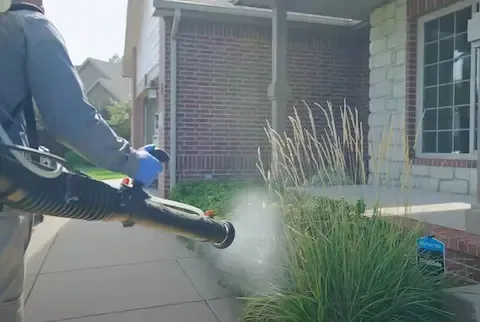
Residential barrier treatments work differently. A trained applicator uses a backpack or powered blower to apply a residual product to the undersides of leaves, shrubs, low branches, and other surfaces where resting adult mosquitoes contact the treated film. Done correctly, this creates a zone of control in your yard that continues working for three to four weeks. For mosquito control that actually corresponds to your outdoor schedule — barbecues, kids playing in the yard, evening gatherings — a seasonal barrier program starting in late May and running through early September is the approach that covers the entire pressure window along the Rock River corridor.
What barrier treatments do not do is eliminate the river itself as a source. New mosquitoes will continue to emerge from the water and move into adjacent properties. That is why frequency matters. A single treatment applied once in July gives you a few weeks of relief. A properly timed program that repeats every three to four weeks keeps the resident population suppressed continuously.
Timing Yard Treatment for Riverside Beloit Properties
Most riverside homeowners make the same mistake: they call for treatment after they have already had enough. By that point, peak pressure is often already underway and populations are at their highest density. For properties near Riverside Park, along the sections of the river that run through the Bluff Street and Riverside Drive areas, and in the neighborhoods immediately adjacent to Beloit's river greenway, the smarter move is to start treatment before pressure peaks.
In Beloit and Rock County generally, meaningful mosquito emergence typically begins in late April to early May, depending on winter snowmelt and spring rain totals. The Rock River floodplain adds volume to this because standing water in low-lying riverside lots can sit for weeks after a wet spring. If you want coverage during Memorial Day weekend — the first major outdoor event of the season for most families — the first treatment needs to be applied in the second or third week of May. That timing also matters because early applications start knocking down overwintered females before they complete their first breeding cycle, which reduces population density for the weeks that follow.
What You Can Do on Your Property Before Treatment
Professional applications work best when source reduction has already been done. Walk your yard with this list before a technician arrives, or just as a first step on your own:
- Empty and flip any containers that hold rainwater — buckets, flower pot saucers, tarps, kiddie pools, clogged gutters
- Drain or treat low spots that hold water more than four or five days after rain
- Trim back dense shrubs and low-hanging vegetation along the fence line or property edge — this removes resting habitat
- Check for ornamental water features; a small fountain pump or biological larvicide tablet keeps a birdbath from becoming a breeding site
- If you have a rain barrel, make sure it has a secure screen over the inlet
Riverside Beloit yards often have one feature that inland yards do not: proximity to large water bodies they cannot control. Eliminating every water source on your property still leaves the river edge within mosquito flight range. That is exactly why source reduction plus a barrier program together outperforms either one alone.
Tick Pressure Along the River Corridor
The same river edge vegetation that supports mosquito populations also provides ideal habitat for blacklegged ticks, sometimes called deer ticks. The trail corridors and overgrown edges near Beloit's river greenway, Riverside Park, and wooded buffer zones along the Rock River are active tick zones during spring and fall. If your yard backs up to any of those areas, or if you or your pets move through that vegetation regularly, tick exposure is a real and separate concern from mosquitoes.
Many barrier spray programs cover both insects with the same application, since the residual products applied to shrubs and ground-level vegetation affect ticks as well. If you want more detail on how that tick component works and what to do if you find one attached, the post on how mosquito work begins covers removal and early monitoring steps that apply directly to Rock River corridor exposure.
Realistic Expectations for Riverside Properties
No residential treatment eliminates mosquitoes entirely when you live next to a river. That is not a flaw in the treatment — it reflects the biology. What a well-executed program does is reduce the population on your property to the point where outdoor time becomes comfortable again. Riverside Beloit homeowners who run a full-season barrier program from mid-May through August consistently report a significant reduction in mosquito activity in treated zones. The river will continue to produce mosquitoes. Your yard does not have to be where they land.
